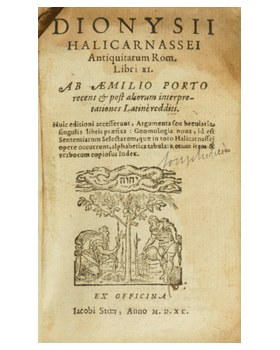
DIONYSII HALICARNASSEI Antiquitatum Rom. Libri XI. AB ÆMILIO PORTO recens & post aliorum interpretationes Latinè redditi. Huic editioni accesserunt, Argumenta seu breuiaria singulis libris præfixa: Gnomologia noua, id est, Sententiarum Selectarum, quæ in toto Halicarnassei opere occurrunt, alphabetica tabula: Rerum item & verborum copiosus Index. Ex Officina Iacobi Stoer, Anno M. D. XC. [1590].
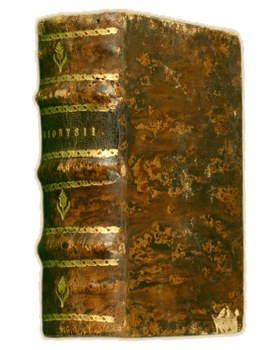
In-16.º de 13,5x9 cm. Com [xxxii], 1082, [xxx] págs. Encadernação do século XVIII, inteira de pele, com nervos, rótulo e ferros a ouro na lombada.
Impressão em caracteres redondos nas páginas preliminares e nos índices; o extenso corpo da tradução latina encontra-se predominantemente composto em caracteres itálicos de tipos muito pequenos. A marca xilográfica de Jacob Stoer ocupa a parte inferior do rosto: dois homens cuidam de uma árvore, iluminada por raios provenientes de uma nuvem onde figura o Tetragrama hebraico יהוה, o nome divino. Texto ornamentado com modestos cabeções e iniciais com motivos vegetalistas.
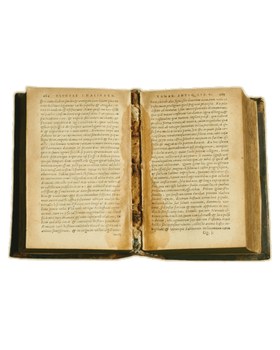
Exemplar com inscrição manuscrita não identificada no rosto. Apresenta notas marginais manuscritas a tinta e em latim, mais frequentes nos primeiros cadernos, assinalando personagens, povos e lugares mencionados no texto, entre os quais Cacus latro, Hércules, Campani, Arcades e Croto. Nas guardas encontra-se uma nota sobre a integração da obra no período greco-latino da literatura grega e apontamentos de venda datados do Porto, 13 de Dezembro de 1985. Nome do autor manuscrito no corte lateral das folhas, permitindo identificar o volume quando arrumado com a lombada voltada para o interior. Desgaste superficial na coifa superior e no canto inferior da pasta anterior. Cortes das folhas acastanhados por sujidade, com pequenas manchas de humidade à cabeça. Abertura pronunciada do miolo junto às págs. 464-465, deixando visível parte da estrutura da lombada e uma mancha de humidade junto ao festo, embora os cadernos permaneçam presos à costura.
Edição quinhentista pouco comum da tradução latina das Antiquitates Romanae preparada por Aemilius Portus, não representada na Biblioteca Nacional de Portugal. A tradução fora publicada pela primeira vez em 1588, em edição in-fólio impressa por Eustache Vignon para Henri Estienne; esta edição genovense de 1590 apresenta-a num compacto in-16.º, acrescida de instrumentos destinados à consulta: um argumento geral, breviários antepostos a cada livro, uma gnomologia alfabética de sentenças e um extenso índice final de nomes e matérias.
As páginas preliminares abrem com o Argumentum rerum, quæ in universa Dionysii historia continentur, exposição da matéria e dos propósitos historiográficos da obra, seguido pela Gnomologia», que reúne alfabeticamente máximas extraídas dos onze livros, sob conceitos como amizade, ambição, paz, pátria, nobreza, necessidade e virtude. Cada livro principia com um breviário numerado dos assuntos tratados. As trinta páginas finais contêm o «Index nominum et rerum», disposto em duas colunas.
As Antiquitates Romanae foram concebidas em vinte livros, narrando a história de Roma desde as origens lendárias até ao início da Primeira Guerra Púnica; sobreviveram integralmente os primeiros onze, que alcançam 441 a.C. Dionísio procurou apresentar as instituições, leis, conflitos civis, costumes e campanhas militares romanas a leitores de língua grega, sustentando simultaneamente a origem helénica de Roma. A abundância de discursos e episódios exemplares explica a utilidade da gnomologia acrescentada a esta edição, que converte a narrativa histórica num repertório de máximas políticas e morais.
A publicação enquadra-se na orientação editorial da oficina de Jacob Stoer durante as décadas de 1580 e 1590, quando o impressor genovense concentrou parte importante da sua produção nos autores gregos e latinos, nos textos jurídicos e nos manuais escolares. O pequeno formato e os índices copiosos tornavam este volume adequado à leitura, ao ensino e à consulta, funções também testemunhadas neste exemplar pelas notas marginais latinas e pelo título antigo inscrito nos cortes.
Dionísio de Halicarnasso (Halicarnasso, ca. 60 a.C. – depois de 7 a.C.) foi historiador grego, professor de retórica e crítico literário. Estabeleceu-se em Roma cerca de 30 a.C., onde ensinou e estudou a língua, as instituições e a tradição historiográfica romanas. Compôs as Antiquitates Romanae em vinte livros, dos quais os primeiros onze subsistem integralmente. Escreveu também tratados sobre composição e oratória, estudos dedicados aos antigos oradores áticos e cartas de crítica literária.
Aemilius Portus, ou Emilio Porto (Ferrara, 1550 – Stadthagen, 1614 ou 1615), foi filólogo e professor de Grego. Filho do helenista cretense Franciscus Portus, ensinou línguas antigas em Genebra desde 1569 e ocupava a cátedra de Grego da Academia de Lausanne quando publicou a sua tradução de Dionísio de Halicarnasso. Foi depois professor de Grego e Retórica em Heidelberg, onde preparou edições e traduções de Eurípides, Aristóteles, Píndaro, Homero e outros autores, além de léxicos greco-latinos dos dialectos jónico e dórico.
Jacob Stoer (Ettlingen, 1542 – Genebra, 1610) foi impressor, livreiro e editor. Chegou a Genebra em 1559, aprendendo o ofício na oficina de Jean Crespin, e trabalhou por conta própria a partir de 1571. Publicou cerca de 368 títulos, com particular incidência em textos religiosos, jurídicos e clássicos greco-latinos; a presente edição pertence ao período em que a sua oficina se afirmou na produção de autores antigos e livros de estudo em formatos de circulação prática.
[EN] In 16mo, 13.5 × 9 cm. [xxxii], 1082, [xxx] pp. 18th-century full leather binding, with raised bands, label and gilt-stamped lettering on the spine.
The preliminary pages and tables of contents are printed in round type; the main body of the Latin translation is predominantly set in very small italic type. Jacob Stoer’s woodcut mark occupies the lower part of the title page: two men tend to a tree, illuminated by rays emanating from a cloud bearing the Hebrew Tetragrammaton יהוה, the divine name. The text is adorned with modest capitals and initials featuring plant motifs.
A copy with an unidentified handwritten inscription on the title page. It contains handwritten marginal notes in ink and in Latin, which are more frequent in the early quires, highlighting characters, peoples and places mentioned in the text, including Cacus latro, Hercules, the Campanians, the Arcadians and Croto. On the endpapers there is a note regarding the work’s place within the Greco-Latin period of Greek literature, and sales notes dated in Porto, 13 December 1985. The author’s name is handwritten on the side edge of the leaves, allowing the volume to be identified when stored with the spine facing inwards. Superficial signs of wear to the top cap and the lower corner of the front cover. The edges of the leaves are browned by dirt, with small moisture stains at the top. There is pronounced gaping of the pages near pp. 464–465, revealing part of the spine structure and a moisture stain near the headband, although the quires remain attached to the binding.
Rare 16th-century edition of the Latin translation of Antiquitates Romanae prepared by Aemilius Portus, not held by the National Library of Portugal. The translation was first published in 1588, in a folio edition printed by Eustache Vignon for Henri Estienne; this Genoese edition of 1590 presents it in a compact 16mo format, supplemented by reference tools: a general table of contents, summaries preceding each book, an alphabetical gnomology of maxims and an extensive final index of names and subjects.
The introductory pages open with the Argumentum rerum, quæ in universa Dionysii historia continentur, an exposition of the work’s subject matter and historiographical aims, followed by the Gnomologia, which brings together, in alphabetical order, maxims drawn from the eleven books, under headings such as friendship, ambition, peace, homeland, nobility, necessity and virtue. Each book begins with a numbered summary of the topics covered. The final thirty pages contain the ‘Index nominum et rerum’, arranged in two columns.
The Antiquitates Romanae were conceived as a twenty-volume work, recounting the history of Rome from its legendary origins to the start of the First Punic War; the first eleven volumes, covering the period up to 441 BC, have survived in their entirety. Dionysius sought to present Roman institutions, laws, civil conflicts, customs and military campaigns to Greek-speaking readers, whilst at the same time upholding the Hellenic origins of Rome. The abundance of speeches and exemplary episodes explains the usefulness of the gnomology added to this edition, which transforms the historical narrative into a collection of political and moral maxims.
This publication is in keeping with the editorial focus of Jacob Stoer’s printing workshop during the 1580s and 1590s, when the Genoese printer devoted a significant part of his output to Greek and Latin authors, legal texts and school textbooks. Its small format and extensive indexes made this volume well-suited to reading, teaching and reference; these functions are also evidenced in this copy by the Latin marginal notes and the old title inscribed on the edges.
Dionysius of Halicarnassus (Halicarnassus, c. 60 BC – after 7 BC) was a Greek historian, teacher of rhetoric and literary critic. He settled in Rome around 30 BC, where he taught and studied the Roman language, institutions and historiographical tradition. He composed the Antiquitates Romanae in twenty books, of which the first eleven survive in their entirety. He also wrote treatises on composition and oratory, studies devoted to the ancient Attic orators, and letters of literary criticism.
Aemilius Portus, or Emilio Porto (Ferrara, 1550 – Stadthagen, 1614 or 1615), was a philologist and professor of Greek. The son of the Cretan Hellenist Franciscus Portus, he taught ancient languages in Geneva from 1569 and held the chair of Greek at the Academy of Lausanne when he published his translation of Dionysius of Halicarnassus. He later became a professor of Greek and rhetoric at Heidelberg, where he prepared editions and translations of Euripides, Aristotle, Pindar, Homer and other authors, as well as Greek–Latin lexicons of the Ionic and Doric dialects.
Jacob Stoer (Ettlingen, 1542 – Geneva, 1610) was a printer, bookseller and publisher. He arrived in Geneva in 1559, learnt the trade at Jean Crespin’s workshop, and worked independently from 1571 onwards. He published some 368 titles, with a particular focus on religious, legal and Greco-Latin classical texts; this edition dates from the period when his workshop established itself in the production of ancient authors and study books in practical formats.
Ref.:
- Bibliothèque de Genève, Cota: S 28711; GLN-3419.
- PAN Biblioteka Kórnicka, Cota: 13915; USTC 451235; Adams D 634.
- Russell, Donald. «Dionysius (7), of Halicarnassus, Greek critic and historian». Oxford Classical Dictionary, 2016.
- Hoche, Richard. «Portus, Aemilius». Allgemeine Deutsche Biographie, vol. 26, 1888, pp. 447-449.
- Dubois, Alain. «Jacob Stoer (1542-1610), un éditeur et ses auteurs». In Riffaud, Alain (dir.). L’écrivain et l’imprimeur. Rennes: Presses universitaires de Rennes, 2010, pp. 75-93.

 Português
 Inglês