Publicação Quinzenal. Director: Wilhelm Reetz. Deutsher Verlag. Berlim. 1942-1944.
16 Volumes de 37x27 cm. Com cerca de 640 págs. Brochados. Profusamente ilustrados com gravuras, desenhos e fotografias a cores e a preto e branco, algumas de página inteira e dupla, e com anúncios publicitários.
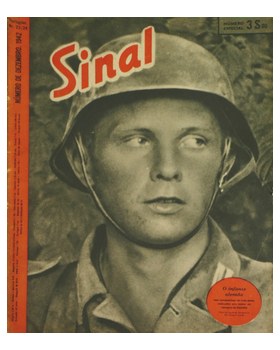
Este conjunto reúne o Número Especial 23/24 do 3.º Ano de Dezembro de 1942, com o seguinte destaque «O Infante Alemão nas Campanhas em Todos os Campos de Batalha» e «Foto do repórter de guerra Pk. Hilmar Pabel» (capa anterior), do 4.º Ano de 1943 tem em falta os n.ᵒˢ 3, 5, 7-14, 16, 18-22, e do 5.º Ano de 1944 tem os n.ᵒˢ 1 a 7.
As revistas de 1942 e de 1943, tem o título em português «Sinal» e as de 1944 já têm o título em alemão «Signal», apesar de serem todas em português.
Esta coleção, com 17 números, constitui um conjunto limitado, mas muito útil para o estudo da mais importante revista de propaganda de todas as guerras do século XX, sendo de destacar o número especial com 70, [ii] págs. no fim de 1942. O seu excepcional valor radica em dois aspetos:
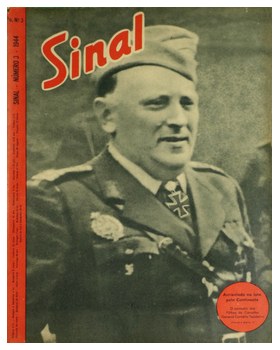
O primeiro, a elevada qualidade gráfica e das fotografias realizadas pelas PK, Companhia de Propaganda do Exército Alemão, sendo um dos fotógrafos conhecidos Pk. Hilmar Pabel. Destacam-se as fotografias da parte exterior e interior das capas, de uma qualidade não atingida pelas outras revistas de propaganda de guerra. As fotografias a cores e a preto e branco têm também uma elevada qualidade, resultante do elevado nível da indústria óptica alemã. Tiveram um forte impacto na época e foram largamente utilizadas em quase todas as obras sobre a 2.ª Guerra Mundial publicadas até aos nossos dias, definindo, assim, de forma marcante, o registo visual da guerra.
A segunda característica do carácter propagandista desta revista é o facto dela não afirmar diretamente a ideologia Nazi, mostrando, pelo contrário, uma Alemanha moderna e com grande desenvolvimento nas artes e na indústria. Inclui também artigos destinados a países neutrais, como Portugal, Espanha, Suíça e outros, e muitas reportagens sobre aspetos lúdicos, desportivos e sociais, que demonstravam uma vida feliz e exultante na Alemanha Nazi. A partir da invasão da União Soviética e dos bombardeamentos dos Aliados sobre a Alemanha, a revista apresenta o regime Nazi como uma vítima e como um defensor heroico da civilização do mundo moderno. As operações militares são sempre vistas de um ponto de vista distanciado e limpo, sem fotografias de mortos, e com as tropas alemãs apresentadas como soldados felizes e heroicos, exercendo uma função estritamente técnica.
Em resumo, a revista é um exemplo paradigmático da propaganda que recorre à omissão (dos horrores da guerra e da ideologia Nazi) e à manipulação por meio da beleza gráfica e fotográfica e de reportagens que encenam a vida na Alemanha e nas frentes de combate.
Além das características indicadas, foi um dos mais extraordinários meios de propaganda, pois o regime Nazi conseguiu publicar edições em 26 línguas diferentes, começando por uma tiragem de 40 000 exemplares e atingindo rapidamente uma tiragem máxima de 2.500.000 exemplares por número. Como a revista não fazia propaganda direta da ideologia Nazi, não estava autorizada a circular na Alemanha.
[EN] 16 volumes. 37x27 cm. Approximately 640 pages. Paperback. Richly illustrated with engravings, drawings and colour and black-and-white photographs, some of which are full-page or double-page spreads, and featuring advertisements.
This set brings together Special Issue 23/24 of the 3rd Year, dated December 1942, featuring the following highlights: ‘The German Infantryman in Campaigns Across All Battlefields’ and ‘Photograph of war correspondent Pk. Hilmar Pabel’ (previous cover); the 4th Year (1943), missing issues 3, 5, 7–14, 16, 18–22; and the 5th Year (1944) containing issues 1 to 7.
The magazines from 1942 and 1943 have the Portuguese title ‘Sinal’, whilst those from 1944 already have the German title ‘Signal’, even though they are all in Portuguese.
This set, comprising 17 issues, is a limited but highly useful set for the study of the most important propaganda magazine of all the wars of the 20th century; of particular note is the special issue with 70, [ii] pages published in late 1942. Its exceptional value lies in two aspects:
Firstly, the high quality of the illustrations and photographs produced by PK, the German Army’s Propaganda Company, one of whose well-known photographers was Hilmar Pabel. Of particular note are the photographs on the front and back covers, the quality of which was unrivalled by other war propaganda magazines. The colour and black-and-white photographs are also of a high standard, reflecting the advanced level of the German optical industry. They had a significant impact at the time and have been widely used in almost all works on the Second World War published to date, thereby making a striking contribution to the visual record of the war.
The second characteristic of this magazine’s propagandistic nature is that it does not directly espouse Nazi ideology; on the contrary, it portrays a modern Germany that is highly developed in the arts and industry. It also includes articles aimed at neutral countries, such as Portugal, Spain, Switzerland and others, and many reports on leisure, sport and social life, which depicted a happy and jubilant life in Nazi Germany. Following the invasion of the Soviet Union and the Allied bombings of Germany, the magazine portrays the Nazi regime as a victim and as a heroic defender of modern civilisation. Military operations are always viewed from a detached and sanitised perspective, with no photographs of the dead, and with German troops portrayed as happy and heroic soldiers carrying out a strictly technical role.
In short, the magazine is a prime example of propaganda that relies on omission (of the horrors of war and Nazi ideology) and manipulation through graphic and photographic beauty, as well as reports that dramatise life in Germany and on the battlefronts.
In addition to the features mentioned, it was one of the most extraordinary propaganda tools, as the Nazi regime managed to publish editions in 26 different languages, starting with a print run of 40,000 copies and quickly reaching a maximum print run of 2,500,000 copies per issue. As the magazine did not directly promote Nazi ideology, it was not authorised for circulation in Germany.
Ref.:
Site Filosofia.org.

 Português
 Inglês