1 Folio. De 13x20 cm.
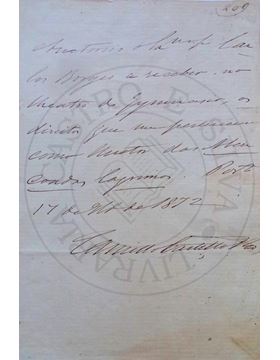
Contém uma mensagem com 7 linhas manuscritas pela mão do escritor Camillo Castello Branco e a assinatura do autor.
Sobreposto a um passe-partout da época com as margens em pele colada sobre vidro.
Conteúdo da mensagem: « António […] Car | los Borges a receber, no | Theatro Gymnasio, os | direitos que me pertencem | como autor das Aben | çoadas Lágrimas | Porto. 17 de Abril de 1872 | Camillo Castello Branco ».
Camilo nasceu em 1825, em Lisboa, e suicidou-se a 1 de junho de 1890, em S. Miguel de Ceide (Famalicão).
A obra Lágrimas Abençoadas teve a sua primeira edição em 1857.
O Teatro do Ginásio – Theatro do Gymnasio no princípio da sua existência – foi um espaço marcante na história do teatro português, tendo acolhido durante mais de um século espetáculos, sobretudo comédias, que divertiram várias gerações. O fim do Ginásio ocorreu em 1952 com a demolição do interior para a construção de um espaço comercial. A classificação como imóvel de interesse público pela Câmara Municipal de Lisboa em 1980 assegurou a preservação da fachada do edifício, sendo este transformado, em 1992, em “Espaço Chiado – Centro Comercial e Cultural Theatro do Gymnasio”.
[EN] MANUSCRIPT AUTOGRAPH - CAMILLIANA – 19th. CENTURY.
1 Folio. 13x20 cm.
Contains a 7-line handwritten message by the hand of the author Camillo Castello Branco with his signature.
Superimposed on a contemporary passe-partout with the margins in leather pasted over glass.
Message content: ' António [...] Car | los Borges to receive, at the | Theatro Gymnasio, the | rights that belong to me | as author of Aben | çadas Lágrimas | Porto. 17 April 1872 | Camillo Castello Branco'.
Camilo was born in 1825, in Lisbon, and committed suicide on 1 the 1st of June 1890, in S. Miguel de Ceide (Famalicão).
The work Lágrimas Abençoadas (Blessed Tears) had its first edition in 1857.
The Teatro do Ginásio - Theatro do Gymnasio in the beginning of its existence - was a landmark in the history of Portuguese theatre, having hosted shows for over a century, especially comedies, which entertained several generations. The end of the Gymnasium occurred in 1952 with the demolition of the interior for the construction of a commercial space. The classification as property of public interest by the Lisbon City Council in 1980 ensured the preservation of the building"s façade, being transformed, in 1992, into 'Espaço Chiado - Shopping and Cultural Centre Theatro do Gymnasio'.

 Português
 Inglês